

The invitation was particularly meaningful to me. My own website, which was launched in January this year, represents a great deal of thought, time, and intentional design. It has evolved over nearly five years, going through many iterations as my ideas about research, communication, and engagement have developed. I am certain it will continue to evolve in the years ahead.
The opportunity to speak with doctoral researchers gave me the chance to reflect on the thinking behind the website, the decisions that shaped its current form, and the broader question of how academics might use digital spaces to communicate themselves, and their work more thoughtfully and effectively.
But the conversation quickly moved beyond websites. It became a discussion about identity. About the many fragments that make up a person. About how those fragments sit together and how we choose to communicate them.
Websites for academics
Academics today leave a curious digital trail. Our names appear in many places at once: university profile pages, ResearchGate accounts, ORCID identifiers, Google Scholar records, LinkedIn profiles, and sometimes personal websites layered on top of all of that. The same information repeats itself in slightly different forms across multiple platforms. Publications appear again and again. Citations accumulate like small trophies arranged across the internet.
It can begin to feel less like communication and more like performance and accolade.
Each platform presents a narrow version of the academic self. A list of outputs. A set of metrics. Evidence of productivity. Yet none of these spaces really captures the individual who stands behind those fragments.
The result is that the academic self becomes fragmented or, even worse, repeated, across these platforms. So, step one is to figure out what is it that you actually do and are passionate about?
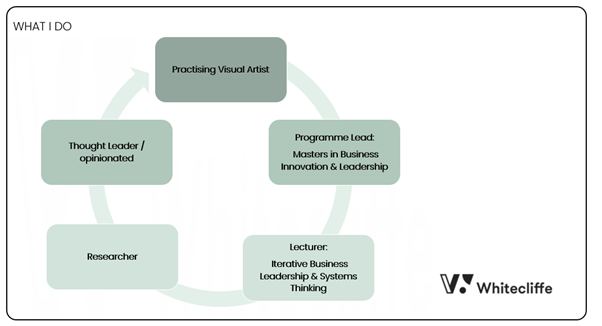
We are collections of interests, curiosities, ideas, and ways of seeing the world. We are contradictions and confusions. These are not separate identities competing with one another. They are connected precisely because we stand at the centre of them.
This was the starting point of the conversation with the doctoral candidates.
What, then, is the real purpose of a website?
What is the purpose of a website?

When I began building my own website in 2021, I did not begin with a clear answer. Like many academics and visual artists, my first instinct was to try and represent every dimension of my work. The structure was complex. Too many categories. Too many explanations. Too many attempts to capture the full scope of professional activity and output. I had options to buy online, high-res images of all my works, details of every exhibition, etc. etc.
It was content heavy and confusing. I removed the sales component realising that I would rather work with galleries and slowly I started narrowing down the various components of my interest.
Eventually, late last year, I refined my focus to two core themes, which are the first elements you encounter when visiting my website.
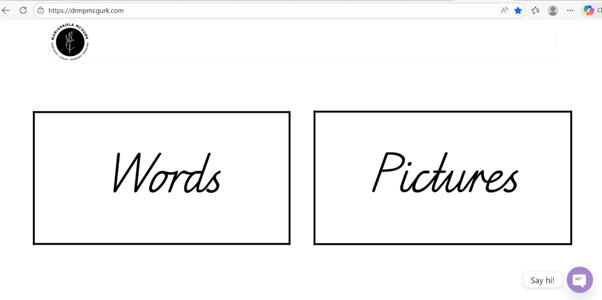
Those two ideas sit quietly at the centre of the website. They hold together the different dimensions of what I do: WORDS: research, opinion pieces, and press; PICTURES: artmaking and exhibitions. They are very different, but they are not separate identities. They are simply different expressions of my curiosities.
Unlike many academic artists, I do not research my artworks; but visual art is the foundation of how I perceive and navigate the world. The practice of making art is an opportunity for inward reflection, a way of finding moments of peace and understanding within what can often feel like a chaotic world.
My research holds a different but equally important role. I believe its intention is to push understanding forward in ways that are both relevant and impactful for how we navigate and improve our society. Our thinking, interests, and lived experiences intersect in complex ways, shaping how we see problems and how we imagine solutions. Business, the cultural and creative industries, systems thinking, innovation, entrepreneurship, developing nations, indigenous cultural are all topics that I find fascinating and love exploring.
As I developed my website, it gradually became less about presenting achievements and more about creating a space where these intersections could be seen. It was an attempt to show the relationship between the different parts of my thinking rather than separating them into neat professional categories.
Who am I actually trying to speak to?
Academic research is often written in a language designed for other academics. It is dense, technical, and shaped by disciplinary traditions, and for many people it can be quite difficult to engage with (and quite boring). This language has its place, and as research filters into society in various ways that rigour remains essential, because precision, methodology, rigour, ethics, and cultural understanding all matter.
But most of the people affected by research are not academics at all.
They are entrepreneurs building businesses. Policymakers designing interventions. Artists shaping cultural conversations. Community leaders trying to solve practical problems. Citizens navigating complex social systems.
When research speaks only in academic language it can unintentionally create distance from these audiences. Jargon can make relevant stakeholders feel excluded from conversations that may directly affect their work or lives. It can make people feel that the knowledge is not meant for them.
Academia should not exist as an isolated island of knowledge.
A website offers an opportunity to create bridges.
It can translate ideas. It can make research visible and understandable beyond disciplinary boundaries, while also revealing the person behind the ideas. It can allow different audiences to find entry points that are meaningful to them. This does not mean that research is diluted, but rather that academics engage in different ways.
But this only works when there is clarity of intention.
- Who are you trying to reach?
- Why would they care?
- What might they gain from engaging with your thinking?
Without answering those questions, a website becomes simply another digital mirror reflecting the same academic narrative already visible elsewhere.
‘Contact Us’
My website does not provide a direct contact email. Instead, if you click on the contact image, you are directed to my social media spaces: LinkedIn, Facebook, and Instagram. This was a deliberate decision.
A website does not need to exist separately from the rest of one’s digital presence. Rather than functioning as a sealed professional container, it can sit at the centre of a wider network of conversations. In this way, the website becomes a starting point that connects to other spaces where dialogue, exchange, and engagement can continue.
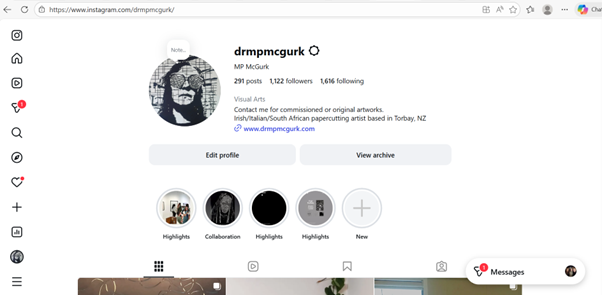
Different social media platforms allow for different forms of expression. My Instagram account is dedicated solely to my visual artwork. My LinkedIn profile focuses on my professional role and the work connected to it. Facebook is a more personal space where I share reflections on family, politics, society, and the world around me.
Each platform offers a different window into who I am and how I think. People can connect with the spaces that resonate most strongly with them.

Some conversations happen through writing. Others through images. Others through informal discussion and shared ideas. The website simply provides a point of orientation from which those conversations can unfold.
Where the website pages take you
There is no need for constant repetition across digital platforms, but alignment is important.
For example, when someone navigates my website and wants to view my artworks, they are directed to my Instagram account.
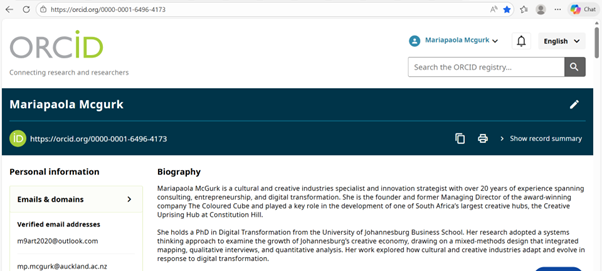
The same thing happens when someone wants to see my research outputs they are taken to my ORCID account which is an academic centralised platform that many journal articles require researchers to have.
The blogpage is the same. This is a platform for me to share my thoughts on any of the topics I am interested in. The blog page is a free WordPress account that I have access to and can update at any point. Having these various plug ins to my website means I am not continually updating a range of platforms. My art is updated every time I post on Instagram, my research and career are updated every time I update ORCID, and my blogs appear directly on my website whenever I write a new blog. The website becomes a culmination of all the components I am working.
In many ways, designing the website became an intellectual exercise rather than a technical one. It required me to think about what matters and how to bring together all the various components by best using the existing platforms, while realising that the audiences are not necessarily the same. Someone interested in my visual arts may have no interest in my research, and someone interested in my opinion pieces may have no interest in my art, etc. The website has to allow viewers to easily navigate their way through the substance and various components.
Why pursue a PhD?
Fewer than 1% of people worldwide complete a PhD, with rates ranging from 0.1% to 2.5% depending on the country. Completing a PhD is a long and demanding journey that requires resilience, consistency, and focus. It is exceptionally difficult to persevere without believing that your research contributes meaningfully to society and aligns with your passions.
A personal website provides a space to showcase those passions and broaden the range of stakeholders you engage with. I realised that the audiences I want to reach are diverse; some are drawn to my work in the arts, others to my opinion pieces, and others to my research. If your primary goal is to enhance academic perception, it might make more sense to focus on increasing research output and maintaining a robust ORCID profile.
To clarify your approach, consider these questions:

Too often, the reasons given for pursuing a doctorate are framed in purely instrumental terms: publish more, build a profile, climb the academic ranks, gain stature in society. But I believe the true value of a PhD lies elsewhere.
It lies in the pursuit of knowledge and understanding. It lies in learning to think deeply about complex systems and difficult questions. It lies in cultivating the intellectual humility to recognise that understanding is always partial and always evolving. The pursuit of knowledge is not a linear career strategy; it is an ongoing intellectual journey.
A website, when approached thoughtfully, can reflect that journey. Not as a mere catalogue of outputs, but as a space where the different dimensions of a curious mind come together. Those fragments only make sense because you stand in the middle of them, navigating the pursuit of knowledge. A key part of that responsibility is how you share what you learn with others. A website offers a unique platform to communicate with a broader audience in ways that are human, relatable, and clear.
My website is not perfect. It is an experiment in finding the best ways to use this digital resource to articulate purpose and meaning. It will continue to evolve as I explore better ways to connect and communicate. But one thing is certain: we do not need more websites simply to showcase how “smart” we are as academics!
*Design is not possible without a great designer! Thank you to Monique and Grapeseed Inc for playing with my ideas and making them a reality! If you want an awesome website designer contact them – www.grapeseedinc.co.za.
