
Introduction
I learnt about systems thinking almost by chance. When I was finalizing my PhD topic, I knew I wanted to focus on the cultural and creative industries and the City of Johannesburg. These were two areas I had researched extensively and worked within, and I knew there was a need for deeper analysis and understanding, particularly to help policymakers recognize and support the ecosystem that already existed, rather than attempting to impose entirely new structures upon it.
During one of our PhD lectures, I heard the term systems thinking for the first time, and it immediately clicked. Not because it was a particularly clever or novel idea, but because it gave me a language for describing what I was already observing on the ground. It provided a way of making sense of the interconnectedness, relationships and patterns within an ecosystem – an approach that I believed could be valuable to policymakers, leaders and anyone seeking meaningful and sustainable change.
What I did not realise at the time was how pivotal systems thinking would become to the way I understand leadership, organisational growth and change, societal development and equality. I also did not realise how fundamentally different this way of thinking is from the traditional linear and hierarchical approaches that continue to dominate leadership, strategy and development.
Once you begin to see the world through patterns, systems and relationships, it becomes increasingly difficult to accept simplistic linear explanations. You start to recognise that change rarely happens in isolation, that outcomes are shaped by relationships and interactions, and that the whole is often far more complex and far more interesting than the sum of its parts.
Systems thinking is both logical and increasingly vital in our contemporary, complex and interconnected world. At its core, it is about recognising the ecosystem, understanding the relationships between its stakeholders, and acknowledging the complexity that exists within it. Complex problems cannot be addressed through simple linear solutions. Instead, they require interventions that recognise existing relationships, enable connections, strengthen what is already working, and create the conditions for new possibilities to emerge.
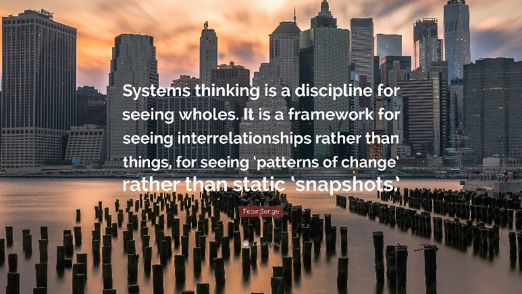
I have had a few people asking me for more information on this topic, as well as where they can read more to better understand it. I lecture on systems thinking as a foundation for iterative business leadership, so this blog is really a starting point: an introduction to what systems thinking means and why it matters in the world we live in today, based entirely on my own understanding and experience.
This is not intended to sound clever or academic. It is simply a straightforward introduction for anyone who wants to take their first steps into systems thinking and perhaps begin looking at the world a little differently. It is also important to clarify that just because something is part of a system does not mean that systems thinking is required or used; systems thinking is an approach to analyzing problems and situations.
Newtonian Reductionism vs Systems Thinking
Leadership is often about problem solving and understanding what kind of problem you are dealing with. This is important because how you approach a problem will shape how you analyze it and, ultimately, how you arrive at a solution.
Students will hear me say over and over again, “you have to get comfortable in the problem space” when dealing with complex problems. For me, this means two things. First, you need to work out whether you are dealing with a linear problem or a complex problem. Second, you need to understand whether the problem is urgent or whether you have the time to explore it properly.
An urgent problem can be very simple, but it still needs to be dealt with quickly because, if it is not, it can develop into something much more complex or complicated.
For example, imagine a student cannot access their online learning material. At first, this is a simple problem. The student needs support from IT to resolve the access issue. However, if the problem is not addressed urgently, the situation can quickly become more complex. The student may miss learning material, fall behind, perform poorly or even fail. They may then make a formal complaint because they believe they failed due to a lack of access and support. The complaint could then be escalated to senior management, a board or an external authority, turning what began as a simple IT problem into a much larger organizational issue.
This is why urgent problems can be either simple or complex. Urgency does not necessarily tell you what type of problem you are dealing with. It tells you how much time you have to respond.
A very common approach to problem solving is the Newtonian reductionist approach, which has strongly influenced traditional scientific enquiry. Reductionism seeks to understand a whole by breaking it down into its individual parts and examining those parts separately. In very simple terms, it treats the world as something that can be understood by identifying its constituent parts and the rules that govern their behaviour.
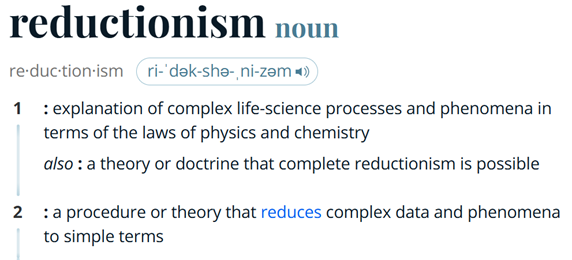
Merriam-Webster.com
This approach can be incredibly useful when dealing with problems that are predictable, bounded and relatively straightforward. If a car breaks down, for example, we can identify the different components, find the faulty part and fix it. We can understand the problem by understanding the parts.
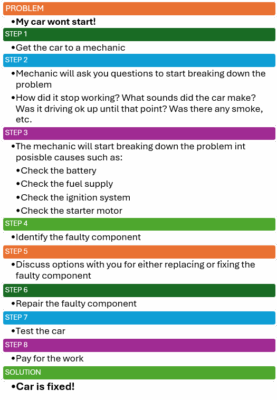
If one were to use systems thinking when a car breaks down, you would probably have a very irritated mechanic! It might go something like this:
“I don’t think the car is actually broken. Let’s spend three weeks mapping the relationships between the battery, the engine, the driver, the road, the weather, the mechanic, the petrol station and the wider automotive ecosystem. Then we can hold a workshop to explore the patterns that emerged.”
Systems thinking would not work very well in this reality! Sometimes you simply need to find the broken part and fix it.
The challenge comes when we apply this same logic to complex human and organizational systems. In these environments, the relationships between the parts matter just as much as the parts themselves. Changing one part can affect everything else, and the outcome may not be predictable.
This is where systems thinking offers a different way of looking at the problem. It does not mean that every problem is complex, or that we should overcomplicate simple problems. It means recognizing when we are dealing with a complex system and looking beyond individual parts to understand the wider system, the relationships within it and the patterns that are emerging.
Systems thinking recognizes that things are interconnected and interdependent, and that the relationships between the parts can be just as important as the parts themselves. It also recognizes emergence and feedback loops, where interactions within a system can create new patterns and behaviours that cannot always be predicted by looking at the individual parts in isolation.
The system is not static. It changes as people, organizations and other elements within it respond to one another. As a result, an intervention that appears to solve one problem can create new problems elsewhere, and there may not be a single solution that permanently resolves the problem in its entirety.
This is perhaps one of the biggest shifts in thinking. Rather than simply asking, “How do we fix this problem?”, systems thinking encourages us to ask, “What is happening within this system, what is creating it, and what can we influence to enable a different outcome?”
It is amazing to me how different the approach to problem solving becomes when you look at the same problem through these two lenses. The entire process is different. You are not simply changing the solution. You are changing how you understand the problem in the first place.
Take a relatable example: a restaurant experiencing a steady decline in customers. The owner knows something is wrong because fewer people are coming through the door and revenue is falling.
The table below is not intended to suggest that one approach is always right and the other is wrong. Reductionist thinking can be incredibly effective for simple, predictable problems. The point is to show how differently we approach a problem when we recognise that we may be dealing with a complex system.
| Reductionist thinking | Systems thinking |
| Problem: The restaurant is losing customers rapidly | |
| 1. Identify the problem Sales have fallen by 20%. | 1. Understand the wider problem What has changed in the environment around the restaurant, and what might be influencing customer behaviour? |
| 2. Break the problem into parts Look at food quality, prices, service, management, opening hours and marketing. | 2. Look at relationships and connections Explore how pricing, food trends, competitors, customer expectations, staff morale, social media, location and the local economy interact. |
| 3. Identify the faulty part Customer reviews show complaints about slow service. The service is identified as the problem. | 3. Look for patterns Slow service appears to be connected to staff shortages, which are connected to low wages and difficult working hours. At the same time, a new competitor has opened nearby, and customers are increasingly looking for faster and more casual dining options. |
| 4. Fix the problem Hire another waiter and introduce faster service procedures. | 4. Understand the feedback loops Staff shortages create pressure → service becomes slower → customer dissatisfaction increases → fewer customers return → revenue falls → the restaurant has less money to employ more staff → pressure on existing staff increases. |
| 5. Measure the outcome Service times improve, so the intervention appears successful. | 5. Consider emergence and unintended consequences Improving service may help, but increasing prices to cover additional staffing costs could discourage some customers. A new menu might attract customers but create greater pressure on the kitchen. One change can create another problem elsewhere in the system. |
| 6. The solution Fix the identified problem and measure whether the outcome improves. | 6. Intervene in the system Experiment with several interventions, such as changing staffing patterns, adjusting the menu, improving working conditions, changing opening hours and responding to changing customer behaviour. Observe what happens and adapt. |
The reductionist approach asks:
“What is causing the problem and how do we fix it?”
The systems thinking approach asks:
“What is creating this situation, what is connected to it, what patterns are emerging, and where can we intervene to influence a different outcome?”
And that, to me, is the really interesting difference. The problem may be exactly the same, but the way we understand it, investigate it and respond to it is fundamentally different.
Perhaps the differences are even more evident when looking at societal challenges (although this effects organisations just as much!) A really good example comes from one of my students, who shared an experience from her own family in a rural town in India.
Her family had owned and operated a traditional tea café for around 20 years. It was an established local business with regular customers and an important place within the community. The government decided to invest heavily in developing the local roads and built a new highway through the town.
From a reductionist perspective, this could be seen as a relatively straightforward development problem. The roads needed to be improved, so a highway was designed and built. The businesses and properties affected by the development were identified, and compensation was provided to those who were displaced.
On paper, the problem had been addressed.
But the wider system told a very different story.
The highway literally went through her family’s business. Although they received compensation and were able to reopen their café at another location, something fundamental had changed. Their regular customers no longer passed the café. The new highway changed the movement of people through the town, meaning that the natural flow of potential customers had disappeared. The business had lost the location, visibility, accessibility and relationships that had supported it for 20 years.
The compensation helped for a short period of time, but it could not recreate the ecosystem that had existed around the original business. Eventually, the café failed.
| Reductionist thinking | Systems thinking |
| Problem: The town needs better roads and infrastructure. | Problem: The town needs better roads and infrastructure, but how will changing the road system affect the wider social and economic ecosystem of the town? |
| 1. Identify the problem The existing roads are inadequate. | 1. Understand the wider system Who and what depends on the existing road network and movement of people? Start consulting and engaging with all stakeholders to better understand the ecosystem, patterns, and relationships |
| 2. Break the problem into parts Design the highway, identify affected properties and businesses, calculate costs and provide compensation. | 2. Map the relationships Consider businesses, residents, customers, commuters, tourism, suppliers, employment, local culture and patterns of movement through the town. |
| 3. Solve the identified problem Build the highway and compensate those directly affected. | 3. Consider what might change What happens when people no longer travel through the same parts of the town? Which businesses depend on passing traffic? What relationships and patterns might be disrupted? |
| 4. Measure the outcome The highway has been completed, traffic can move more efficiently and affected businesses have received compensation. | 4. Consider emergence and unintended consequences The highway changes customer behaviour, traffic patterns and the viability of local businesses. Some businesses may benefit while others may disappear. |
| 5. The solution The infrastructure problem has been solved. | 5. Intervene with the wider system in mind Could the highway be designed differently? Could alternative access, business relocation, transition support or new commercial areas help maintain the local economic ecosystem? |
| Underlying assumption: If we solve the infrastructure problem and compensate those directly affected, we have addressed the consequences. | Underlying assumption: Changing one part of a system can change the behaviour of the whole system, including relationships and patterns that may not be immediately visible. |
What I find particularly powerful about this example is that the highway itself was not necessarily a bad idea. Better infrastructure can bring enormous benefits to a community. The problem was that the intervention appears to have been considered primarily as an infrastructure problem rather than as a change to a much larger social and economic system.
The family received compensation for what they lost, but what they actually lost was much bigger than the physical building. They lost a location, a flow of customers, visibility, relationships, habits and 20 years of embedded connections within the community. Those things are much harder to identify, measure and compensate for. This is where systems thinking becomes particularly important for societal problems. You cannot always see the consequences of changing one part of a system by looking only at that part.
The highway changed the road.
The road changed how people moved through the town.
The movement of people changed where customers went.
Where customers went changed which businesses survived.
And when local businesses changed, the social and economic fabric of the community changed with them.
That is a system.
Conclusion
One important clarification is that systems thinking does not mean that everything is complex, or that every problem requires us to map relationships, explore feedback loops and spend three weeks trying to understand the wider system!
Some problems are simple, predictable and have relatively straightforward solutions. If your car has a flat battery, you probably do not need to understand the entire automotive ecosystem before replacing it. Sometimes you simply need to fix the broken part.
The point is not to use systems thinking for everything. The point is to recognise when you need it.
This becomes particularly important when we are dealing with wicked problems and complex human and organizational systems. These are the problems where there is rarely a single cause, where different perspectives and interests collide, where changing one part can create consequences somewhere else, and where the outcome of an intervention may be difficult to predict.
This is where I find systems thinking particularly powerful.
It gives us a way to sit with complexity rather than immediately trying to reduce it. Instead of assuming that we can isolate the problem, identify the cause and apply the solution, we can explore what is happening across the system, how the different parts interact, what patterns are emerging and what might be maintaining the situation in the first place.
That shift matters enormously in the contemporary world.
Reductionist thinking has given us extraordinary things. It has allowed us to isolate variables, understand individual components, develop scientific knowledge and solve many problems with remarkable precision. The problem is not reductionism itself. The problem is what happens when we apply a reductionist way of thinking to problems that cannot be understood by looking at their parts in isolation.
And we do this all the time.
We reduce a social problem to a single cause. We reduce organisational problems to the actions of an individual. We create policies to address one part of a problem without considering what those policies might change elsewhere. We restructure organisations, change incentives, introduce new technologies or implement new processes and then become surprised when people respond in ways we did not anticipate.
People, organisations and societies are not machines.
They are dynamic, interconnected systems. People respond to change. They adapt, resist, collaborate, reinterpret and create new behaviours. Relationships change. Context changes. The system changes.
This is why systems thinking has become increasingly interesting to me. It does not necessarily give us the answer. In many complex situations, there may not be one answer. What it gives us is a different way of engaging with the problem – one that allows us to see more of what is happening before we decide what to do about it.
Sometimes you need to fix the broken part.
Sometimes you need to understand the system that keeps producing the problem.
Knowing the difference is where systems thinking becomes really interesting.
Exploring further
If this has sparked your interest, there are plenty of accessible ways to explore systems thinking without immediately disappearing into complicated academic literature.
A good place to start is simply to see systems thinking in action. A few examples that I use with students include:
- Systems Thinking: A Cautionary Tale (Cats in Borneo): a wonderfully simple example of how an intervention intended to solve one problem can create consequences elsewhere in the system : Systems thinking: a cautionary tale (cats in Borneo)
- The Power of Systems Thinking: Changing How We See the World, Petri Uusikylä: an accessible introduction to the idea of seeing problems differently The power of systems thinking: changing how we see the world | Petri Uusikylä | TEDxVaasa
- How to Think SO Clearly People Assume You’re Brilliant, Sandeep Swadia: an interesting exploration of how we make sense of information and approach problems Think SO Clearly People Assume You’re Brilliant: How To Think SO Clearly People Assume You’re Brilliant
- Emergence – Flight of the Starlings: a beautiful visual example of emergence and how complex patterns can arise from relatively simple interactions: Flight of the Starlings: Watch This Eerie but Beautiful Phenomenon | Short Film Showcase
- Emergence: How stupid things become smart together: Emergence – How Stupid Things Become Smart Together
And perhaps that is a good place to finish.
Once you start looking at the world through a systems lens, you begin to notice things that are difficult to see when you are only looking at the individual parts. There are numerous frameworks that can support systems thinking analysis, but for me, the most important thing is the mindset behind them: being willing to see the whole, recognize patterns and relationships, engage with the people within the system and, perhaps most importantly, become comfortable enough in the problem space to sit with it for long enough to understand the ecosystem before rushing to find a solution.
You start noticing the relationships.
The patterns.
The unintended consequences.
The things that keep happening even when everyone is trying to fix them.
And sometimes, that is where the really interesting part of the problem begins.
